


Clinical Pilates vs. Reformer Pilates: What's the Difference?

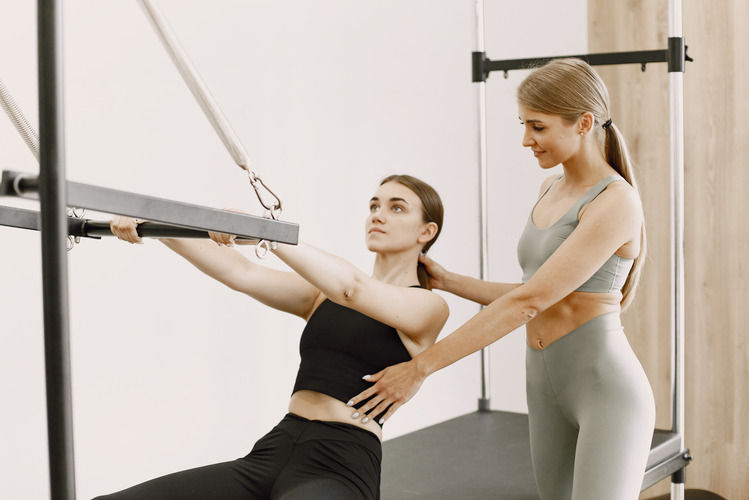
If you've been looking into Pilates, particularly because something in your body hasn't been feeling quite right, you've probably come across a few different terms.
Clinical Pilates. Rehabilitation Pilates. Reformer Pilates. They all sound slightly different, yet the photographs often show people using exactly the same equipment.
It's understandable to wonder whether you're supposed to choose between them. Is one more suitable for injuries? Is the other a proper workout? And do you need to complete one before you're ready for the other? The answer is actually quite simple, although there are a few things worth knowing.
Clinical Pilates generally describes an approach to movement, often connected to healthcare, rehabilitation, or specific physical needs. Reformer Pilates describes Pilates performed using a particular piece of equipment. That means you could be doing clinical Pilates on a Reformer, or using the same machine for a completely different purpose.
At Dynamic Pilates, we spend much more time thinking about the person using the equipment than the name of the exercise they're doing. After all, two people can perform what looks like the same movement and have very different experiences of it. Let's look at what these terms mean and how to work out which approach might suit you.
Is Clinical Pilates the Same as Reformer Pilates?
Not quite, although they can have quite a lot in common.
Think about two people lying on Reformers, both pushing against the footbar with their feet. From across the room, you might assume they're doing exactly the same exercise.
But one person might be rebuilding strength after a knee injury, while the other is working on general fitness. One may need additional support, a smaller range of movement, or lighter resistance, while the other is ready for more challenge.
The equipment is the same, but the intention behind the exercise is different.
Clinical Pilates generally places more emphasis on an individual's physical condition, movement needs, and recovery goals, often under the guidance of a healthcare professional. Reformer Pilates simply refers to the equipment being used, which can support everything from introductory exercises to more demanding strength and coordination work.
This is why we wouldn't necessarily ask someone to choose between the two before understanding what they're hoping to achieve.
What Is Clinical Pilates?
Clinical Pilates is often associated with physiotherapy and rehabilitation settings. It uses Pilates-based exercises as part of an individualized approach to improving movement, strength, and physical function.
Someone recovering from an injury may need a very different program from someone managing persistent back discomfort. Even two people with similar symptoms might respond differently to the same exercises.
That's where individual assessment and exercise selection become important.
Rather than working through a standard class routine, the exercises are chosen around a person's needs. The difficulty can then be adjusted as they gain strength, become more comfortable, or progress through their recovery.
According to Physiopedia, Pilates incorporates controlled movement, coordination, and muscular engagement and can be used within rehabilitation programs.
One thing to be aware of is that the term clinical Pilates isn't used consistently across every studio or healthcare provider. Some reserve it for treatment delivered by physiotherapists, while others use it more broadly to describe a therapeutic, individualized approach to exercise.
It's always worth asking who will be teaching your sessions and whether they have the appropriate qualifications for the care or instruction you need.
Where Does Rehabilitation Pilates Fit In?
This is another area where the language can become a little confusing.
Rehabilitation Pilates generally refers to Pilates-based movement used to support someone's recovery or return to activity. Clinical Pilates is more closely associated with the healthcare setting or professional framework in which that movement is delivered.
There's plenty of overlap between the two, but they aren't necessarily interchangeable.
At Dynamic Pilates, we often meet people who have finished physiotherapy but don't quite feel ready to return to their usual activities. They may have been cleared to exercise, yet still feel uncertain about how much they can do or whether certain movements are appropriate.
That transition can take time.
Perhaps your back no longer hurts the way it did, but you're still hesitant to bend or lift something. Maybe your knee feels better, yet you notice yourself relying more on the other leg when climbing stairs.
These are the kinds of everyday observations that can help shape a thoughtful movement program.
Our approach isn't to replace physiotherapy or provide medical treatment. It's to help people explore appropriate movement, develop strength, and become more comfortable using their bodies within the guidance they've received.
We've explored the distinction further in our article on rehabilitation Pilates vs. clinical Pilates.
What Is Reformer Pilates?
The Reformer is probably one of the most recognizable pieces of Pilates equipment, although it can look rather complicated when you first see one.
There's a sliding carriage, springs, straps, a footbar, and various ways to adjust the setup. Until someone shows you how it works, it's not always obvious what you're supposed to do with everything.
But those adjustable components are exactly what makes the Reformer so useful.
The springs can provide resistance, making an exercise more demanding, but they can also offer assistance. That means we can sometimes use the equipment to make a movement more accessible rather than more difficult.
For example, imagine someone who finds it uncomfortable to perform a squat. Working on the Reformer in a supported position may allow them to explore bending and straightening their knees without having to manage their full body weight in the same way.
For someone else, we might use that equipment to challenge leg strength, coordination, or stability.
There's also much more to Reformer Pilates than lying down and pushing against springs. Exercises can be performed sitting, kneeling, standing, or in other positions depending on what you're working toward.
It's one reason we enjoy teaching with the equipment. There's a great deal of flexibility in how we can use it, and sometimes a small adjustment changes the entire experience of an exercise.
If you're curious about the machine itself, our guide to what Reformer Pilates is explains the different parts and how they're used.
What's the Difference Between Clinical and Reformer Pilates?
The simplest distinction is that clinical Pilates describes the approach and its purpose, while Reformer Pilates describes the equipment.
Here's how the two generally compare.
Clinical Pilates | Reformer Pilates | |
What it describes | An individualized, often healthcare-related approach | Pilates performed on a Reformer |
Main focus | Specific physical needs, recovery, or functional goals | Strength, mobility, coordination, and movement |
Starting point | Often a clinical assessment | Individual experience, ability, and goals |
Equipment | Mat, Reformer, or other Pilates apparatus | Primarily the Reformer |
Common setting | Healthcare or rehabilitation settings | Pilates studios, clinics, and fitness facilities |
Progression | Guided by condition, symptoms, and response | Adapted to the person and purpose of the session |
Of course, real movement doesn't fit quite so neatly into a table.
A person attending a clinically guided session may spend much of their time on a Reformer. Someone attending a general Reformer session may also receive considerable individual attention and exercise modifications.
The difference often comes down to why the exercises have been chosen, who is guiding them, and what you're hoping to achieve.
Can Clinical Pilates Be Done on a Reformer?
Yes, and the Reformer can be particularly useful when exercises need to be adjusted for different abilities or physical limitations.
One of the things we like about spring-based equipment is that it gives us options. We can change the resistance, alter a person's position, or provide more support without necessarily changing the entire exercise.
Let's say someone is working on improving strength around their hips.
On a mat, an exercise might require them to stabilize their entire body while moving one leg. That can be quite challenging, particularly if they're still learning how to coordinate the movement.
On a Reformer, we may be able to introduce a supported variation that allows them to concentrate on a particular part of the movement before increasing the challenge.
That doesn't mean the Reformer is always the better choice. Sometimes a mat exercise is exactly what someone needs, and other times equipment such as the Cadillac, chair, or barrels offers a more useful starting point.
At Dynamic Pilates, our contemporary Pilates approach gives us the freedom to work with different apparatus rather than follow one fixed sequence for everyone.
What Does Research Tell Us?
There has been growing interest in how Pilates may help people with certain musculoskeletal conditions, particularly chronic back and neck pain.
A 2025 randomized controlled trial involving 54 women with chronic lower back or neck pain found that participants completing a Reformer Pilates program experienced improvements in pain intensity, fatigue, and some psychological factors related to pain.
That's encouraging, although it's important to remember that it was a relatively small study. Results from one group don't automatically tell us how every person with back or neck pain will respond.
A separate systematic review examined mat-based Pilates for middle-aged and older adults with chronic musculoskeletal conditions. It found benefits for some measures of pain and physical function, although Pilates wasn't consistently more effective than other types of exercise.
What we take from research like this is that Pilates can be one useful way to approach exercise and movement, but there's no single method that's right for everyone.
If back discomfort is part of what brought you to Pilates, you may also find our article on Reformer Pilates for back pain helpful.
Which Type of Pilates Is Right for You?
This is usually the question people are hoping to answer, and we'd suggest starting with something simpler than the name of a class.
What would you like to feel more comfortable doing?
Perhaps it's getting back to gardening after an injury, sitting through a workday without feeling so stiff, or simply becoming stronger because you've noticed everyday activities taking more effort than they used to.
Those are all useful starting points, and they tell us much more than whether you've decided you want clinical Pilates or Reformer Pilates.
If You're Recovering From an Injury
If you're still receiving medical treatment or recovering from surgery, your healthcare provider should guide when and how you return to exercise.
Once you're ready, Pilates-based movement may be one way to begin rebuilding strength, coordination, and confidence.
We often find that people are particularly interested in the transition after physiotherapy. They may be feeling better but are still unsure how to return to regular exercise or introduce more challenging movement.
That's where individualized instruction can be helpful, provided you're ready for that stage of activity.
You can read more about how the approaches differ in our article on Pilates vs. physiotherapy.
If You Feel Stiff or Restricted
Sometimes there's no obvious injury behind someone's interest in Pilates.
You might spend most of your day sitting, notice that turning your head feels easier in one direction, or feel that your hips have become less comfortable moving through certain positions.
It's tempting to assume that feeling stiff means you simply need to stretch more, but that isn't always the whole picture.
Strength, stability, coordination, and how comfortable your body feels in different positions can all influence movement. Rather than only trying to stretch whatever feels tight, we like to look at how the body is working as a whole.
It's often surprising how a different position or a little more support can change the way something feels.
Persistent or unexplained pain should always be assessed appropriately, but for general movement goals, Pilates offers plenty of opportunities to explore these differences.
If You Want to Feel Stronger
You certainly don't need an injury or a specific physical concern to enjoy Pilates.
Some people come to us because they want to improve strength, challenge their balance, or find a form of exercise they genuinely enjoy.
Reformer Pilates can be a lovely way to work on these things. The adjustable springs give us opportunities to introduce resistance, vary the exercises, and gradually increase the challenge as someone becomes more comfortable.
And being stronger doesn't always mean lifting heavier or working harder every session.
Sometimes progress looks like being able to control a movement that used to feel awkward. Sometimes it's noticing that your balance has improved or that an exercise which once required a lot of concentration now feels much more natural.
These changes may not look particularly dramatic from the outside, but they're meaningful to the person experiencing them.
If you're considering reformer pilates vancouver sessions, it's worth choosing an approach that allows room for that kind of individual progression.
If You're Completely New to Pilates
You don't need to decide which kind of Pilates you want before you've even tried it.
In fact, we'd rather start by asking a few questions about you. What interests you about Pilates? Have you enjoyed other kinds of exercise? Is there anything you're feeling unsure about?
The answers help us understand where to begin.
For someone completely new to structured exercise, we might introduce a few simple movements and spend time explaining how the equipment works. Someone with previous movement experience may be comfortable starting somewhere quite different.
Our Pilates for beginners sessions offer an opportunity to explore these foundations with guidance, rather than feeling you need to know what you're doing before you arrive.
Is Clinical Pilates Covered by Extended Health Insurance?
This is a question worth asking, especially because the word clinical can make a Pilates session sound like something that would automatically be covered by health benefits.
Unfortunately, it isn't quite that straightforward.
Coverage depends on your benefits plan, the type of service being provided, and the qualifications of the professional delivering it. Pilates instruction in a studio isn't necessarily covered in the same way as physiotherapy.
At Dynamic Pilates, our Pilates sessions aren't billed through extended health insurance. Some clients may be able to use a Health Savings Account, depending on their plan, but it's best to confirm eligibility with your provider before booking.
If you have questions about our sessions or how they work, you're always welcome to contact us.
Does the Instructor Matter More Than the Equipment?
We think the instructor makes a considerable difference, particularly when you're new to Pilates or have specific movement concerns.
You could have access to a studio full of beautiful equipment, but the equipment itself can't tell you whether an exercise is appropriate or notice when you're compensating somewhere else.
A good instructor pays attention to those details.
Perhaps you're working through an exercise and everything seems fine, but you're gripping through your shoulders without realizing it. Or maybe one leg is doing most of the work, even though the movement feels quite even to you.
Sometimes all that's needed is a small adjustment. Other times, it makes more sense to change the exercise entirely.
That's also why we value having different Pilates apparatus available at Dynamic Pilates. The Reformer might be useful for one movement, while the Cadillac, chair, or mat offers a better option for another.
Our private Pilates sessions allow us to spend time understanding how someone moves and what they're hoping to work toward.
There's no need to make every session harder or introduce something new simply for the sake of variety. Sometimes revisiting a familiar movement with a little more control is exactly where the progress happens.
Ready to Find the Right Starting Point?
If you've been trying to decide between clinical Pilates and Reformer Pilates, hopefully the distinction feels a little clearer now.
One describes an approach that's often connected to healthcare and recovery, while the other describes the equipment used during a Pilates session. They can overlap, and neither tells you everything about what your experience will be like.
At Dynamic Pilates, our Fairview, Vancouver studio offers personalized movement instruction using the Reformer, Cadillac, chair, barrels, mat, and other Pilates equipment.
Some people come to us after finishing physiotherapy. Others simply want to become stronger, explore their mobility, or try something different from the exercise routines they've followed before.
We don't expect everyone to have the same starting point, and we don't think they should.
If you'd like to find out what might work for you, explore our private Pilates sessions or book an appointment.
You don't need to arrive knowing which equipment you should use or which exercises are right for you. We can start with a conversation about what you'd like to work on and go from there.
Sources
Denham-Jones, L., et al. (2022). A systematic review of the effectiveness of Pilates on pain, disability, physical function, and quality of life in older adults with chronic musculoskeletal conditions. Musculoskeletal Care. https://pubmed.ncbi.nlm.nih.gov/34028164/
Physiopedia. (n.d.). Pilates. https://www.physio-pedia.com/Pilates
Şahan, N., et al. (2025). Effects of Reformer Pilates on pain, psychological factors, and sleep in chronic musculoskeletal pain: A randomized controlled trial. BMC Psychology. https://doi.org/10.1186/s40359-025-03207-9


Comments